Protecting four endangered sea turtle species in the northeastern Caribbean
St. Eustatius, fondly known as "Statia," is a beautiful small volcanic island covering 8 square miles in the northeastern Caribbean. It is 150 miles east of Puerto Rico and 90 miles east of St. Croix. About 2,000 people live on the island which is a municipality of the Netherlands Antilles. The official language is Dutch, and most residents also speak English.
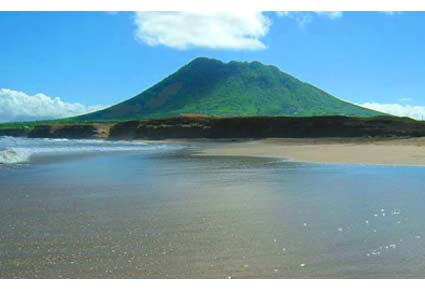
With almost two miles of deserted volcanic sand, Statia's Zeelandia Beach has long been a favored nesting site of four endangered species of sea turtles — the leatherback, green, hawksbill and loggerhead.
Zeelandia Beach, favored nesting site for sea turtles
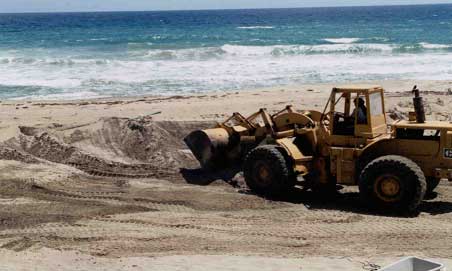
Recently, local companies have been mining sand on Zeelandia. Joy riding in motorized vehicles has further eroded the beach. All this has been at great expense to the sea turtles that nest on Zeelandia Beach and the hatchlings.
Sand mining on Zeelandia Beach
In an effort to prevent further sand erosion by human activity and to afford some protection to the nesting sea turtles, The St. Eustatius National Parks Foundation (STENAPA) succeeded in a quest for Zeelandia beach to be protected. In August 2001, the St. Eustatius government granted Zeelandia Beach protected status. As a further step, in 2002, STENAPA began a sea turtle protection and monitoring program at Zeelandia in affiliation with the Wider Caribbean Sea Turtle Conservation Network (WIDECAST).
In just two short years of dedicated work, the STENAPA sea turtle program has already made significant strides by involving local residents, tourists, off-islanders, and volunteers. Activities and program results include:
Morning and evening patrols of Zeelandia Beach four nights per week during nesting season, with assistance from the Working Abroad Volunteer program. The presence of volunteer crew on the beach at night greatly helps reduce egg poaching, sand mining, joy riding, and other activities detrimental to the sea turtles. At the same time, the sea turtles and their nests are monitored.
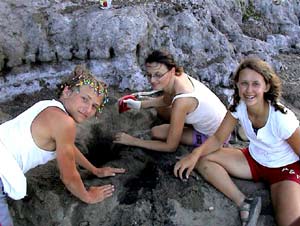
With the help of Broadreach (Semester at Sea students), a hatched nest was located and excavated. A green hatchling that was stuck under a rock was saved.STENAPA Park Manager Nicole Esteban holding the green hatchling that was saved. (Turtles and nests should not be touched without proper authorization and training.)
Training for STENAPA Park Manager Nicole Esteban, and staff member Rozenn Le Scao. They went to St. Croix, Virgin Islands, to improve their skills in data collection related to nesting turtles, turtle tagging, nest relocation, beach monitoring practices, nest monitoring, volunteer training, and added to their knowledge of sea turtle biology and reproduction. Funding for the training was provided by WIDECAST.
After hurricanes passed near Statia, the sea was rough and part of a hawksbill nest washed away. During the last week of incubation, while patrolling the beach staff found the rest of the eggs still in place. During relocation, the hatchling seen here decided to crawl out and make it to the sea. The rest of the eggs were reburied and 7 days later they all successfully hatched.
Educational presentations about sea turtle biology, conservation, habitat, nesting behavior, and hatchlings. Presentations have been made at all five island schools. In 2003, STENAPA lectured on its sea turtle monitoring program at Statia Terminals, a private company on Statia that provides marine terminaling services for crude oil. About 100 employees attended the series of lectures.
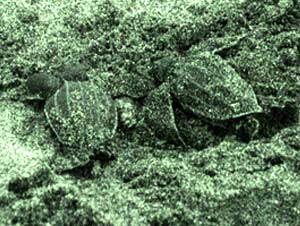
Newly rescued Leatherback hatchlings. (Turtles and nests should not be touched without proper authorization and training.)New arrival green turtle
Continuous beach clean-ups performed year round by teams of volunteers. Trash that is potentially harmful to turtles, such as fishing lines and plastic bottles, is removed and disposed of.
Posting a signboard at the entrance to Zeelandia Beach, with government approval, stating "No driving is allowed on Zeelandia Beach." This will help to protect nests that are potentially destroyed by automobiles and recreational vehicles.
Increased awareness of marine park activities on St. Eustatius, which will hopefully reinforce resident and government recognition of the importance of sea turtle conservation on Statia.
Ongoing objectives include the tagging of all nesting sea turtles on Zeelandia Beach for purposes of data collection and monitoring, relocating nests that are in erosion zones, and monitoring the emergence of hatchlings to ensure their safe arrival to the sea. Overall goals of STENAPA's sea turtle program are as follows:
To protect endangered species by increasing knowledge about population numbers, life cycles, migration, etc.
To reduce impacts on turtle populations by preventing predation of hatchlings on entry to sea, conducting beach clean-up, relocating nests from erosion sites, etc.
To follow the example of St. Croix, in which it appears that nesting sea turtle populations are significantly increasing (i.e., 18 nesting Leatherback turtles recorded 1982, and 186 in 2001).
STENAPA is a not-for-profit foundation that receives no permanent government subsidies. It is mandated by the island's government to manage Statia's Marine Park, National Parks and Botanical Gardens. STENAPA relies on grants and minimal income from divers, yachts, and hikers to finance its ongoing programs and specific projects.
Please donate generously to support STENAPA's sea turtle conservation and monitoring program. Your donation will help support the organization's efforts to preserve the nesting site at Zeelandia Beach for its nesting leatherback, green, hawksbill and loggerhead sea turtles.